City Journal brings the sad news of the death of Fred Siegel. When my partners and I were starting up the New York Sun, Fred was so encouraging that he sent us one of his sons, Harry, as a potential hire. Harry turned out to be a valuable contributor, and Fred a regular inspiration and source of encouragement.
Fred lived in Brooklyn and had been there long enough to appreciate the city's downs and ups, and the causes of both. Going through emails, I see a link to a 2011 piece by Michael Powell of the New York Times:
Fred Siegel, a historian at the conservative-leaning Manhattan Institute, has written of the "New Tammany Hall," which he describes as the incestuous alliance between public officials and labor.
"Public unions have had no natural adversary; they give politicians political support and get good contracts back," Mr. Siegel said. "It's uniquely dysfunctional."
In a recent speech at the Ronald Reagan Presidential Library, the governor of Virginia, Glenn Youngkin, spoke about competition among the states.
"It is extraordinary to look at U-Haul data. I do it all the time," Youngkin said. "What you will see is that Virginia was ranked 32st in 2021, with one-way moves out of Virginia. And one year later, in 2022, we are ranked 5th with one-way moves into Virginia."
"I love competition and I bring it to governing," Youngkin said. "If you are resting, someone else is working. If you are raising taxes and putting criminals first and neglecting education, people are going to leave for states with lower cost, better safety, and better opportunity."
Youngkin spoke of "American families making the choice every day as to where they want to build their lives."
Bloomberg News reports that Goldman Sachs held its annual shareholder meeting in Dallas, Texas, where it is developing a new "regional campus" to house about 5,000 employees.
"The region is sweeping in high-profile dealmakers, wealth-management firms and industry giants, as firms and their executives relocate to Texas from higher-cost states including California and New York," the article says, mentioning JPMorgan Chase & Co, Wells Fargo & Co., Charles Schwab, TIAA, Ken Fisher, and Fidelity among "more than a dozen significant financial services expansions in the region since the start of 2021."
watch a third-party bid. The centrist group No Labels says it's provisionally attempting to get on the ballot in all 50 states. We'll see how that works. But a third party, if it comes, could have real and surprising power in this cycle. I am the only person I know who thinks this but, again, look at people's faces when you say it will be Trump or Biden.
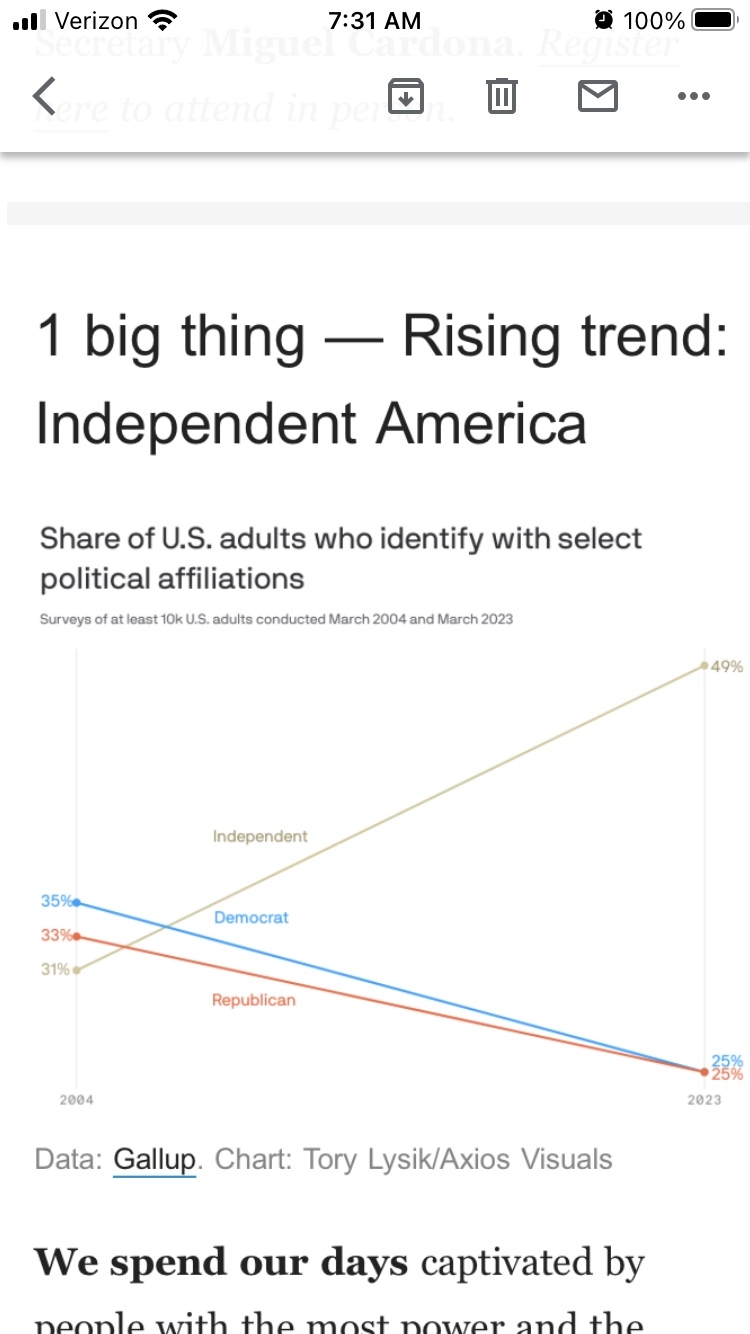
Independents now outnumber members of each party. No hunger for a third-party effort is discernible in the polls. So the effort would have to blow people out of their comfortable trenches and make them want to go over the top to seize new ground. It would have to be something centrists, by their nature, aren't: dramatic. The people who would lead such an effort worry about whether or not they'd wind up as spoilers for the Democrats. You could argue as well it might spoil things for the Republicans.
"All my financial adviser pals and I are telling people to leave the state," says Susan Kaplan of Newton's Kaplan Financial Services. "Do not hold philanthropic holdings here; do not start a business here. Do not live in this state."
The Boston Globe reports, April 9, 2023:
Drew Josephson and Andrew Ventura, Compass real estate agents who dub themselves "relocation specialists" in Naples, Fla., say they've seen an uptick in interest from Massachusetts residents in the past few months.
"I have one client who is looking simply because of the millionaires tax in Massachusetts," Ventura said. "An extra 4 percent on their income pays for a house in Naples."...
Via Axios and Gallup comes this chart showing a tremendous increase in voters identifying as independents rather than as Democrats or Republicans.
The former governor of Maryland, Larry Hogan, and the former senator from Connecticut, Joe Lieberman, are co-chairs of a "No Labels" political organization that is considering fielding a presidential ticket that would be an alternative to Biden and Trump and that could potentially be well positioned to seize on this trend.
The 1980 movie "Caddyshack" includes a memorable scene in which a swimming pool, teeming with swimmers, is hurriedly evacuated and drained. Swimmers had spotted a floating brown object, misidentified it, and reacted by panicking.
"I want the entire pool scrubbed, sterilized, and disinfected," a character orders, as a laborer clad in a hazmat suit and gas mask swabs the floor of the pool.
The floating brown object turned out to be a chocolate bar. "It's no big deal," the pool man declares before casually eating a bite.
A front page news article in today's New York Times refers to "President Biden's economic agenda, which aims to reduce the nation's $7 trillion of uncollected tax revenue and use the funds to combat climate change, curb prescription drug prices and pay for other initiatives prized by Democrats."
The phrase "$7 trillion of uncollected tax revenue" was a new one to me. What you and I think of as "private property," Biden and the New York Times refer to as "uncollected tax revenue."
Treasury Secretary Yellen is out talking about this "$7 trillion" number publicly. On April 4, she said, "Absent our new investment in the IRS, the tax gap – the gap between taxes owed and those actually paid – was estimated at around $7 trillion over the next decade."
Silicon Valley Bank had lots of valuable, safe, liquid assets, and it is a US bank with access to the Federal Reserve. It seems like it should have been fairly straightforward for SVB to pledge those assets to the Federal Reserve to borrow enough money to meet its deposit outflows.
And in fact SVB tried to do that, and it apparently did have enough collateral to borrow enough money to pay out its depositors that Thursday, though I'm not sure it would have survived the weekend. But the problem, that Thursday, was not that SVB had insufficient assets; the problem was that the Fed's computer systems stopped working at 4 p.m. California time, and SVB missed the cutoff to transfer assets and borrow money. Silicon Valley Bank certainly had financial problems ... but the reason it failed that day was mostly operational, not financial.
A new WSJ/NORC poll reports some striking findings, among them that those who say religion is "very important" has declined to 39 percent in 2023 from 62 percent in 1998 and 48 percent in 2019. The poll aligns generally with other recent findings from Gallup and Pew indicating long-term trends of declining attendance at religious services, declining church membership, and declining belief in God. The WSJ/NORC poll had 32 percent of respondents saying they "never" attend religious services and 19 percent saying "less than once a year." A pdf of the poll results is here.

 Continue Reading