Amid all the extensive press coverage of GM's decision to recall vehicles because of an ignition problem and take a $300 million charge, there's been little attention paid to the question of what, if anything, the federal officials who were overseeing GM through its taxpayer-funded rescue knew about it. I emailed Steven Rattner to ask what, if anything, he knew and he didn't email back, even just to say no comment. The whole story — company covers up known flaw that causes cars to stall mid-trip, causing fatal crashes — doesn't really match the "Detroit is back" narrative that was a feature of President Obama's re-election campaign.

What Did the Car Czar Know and When?March 18, 2014 at 1:39 pm
Richard Epstein on the California Carbon TaxMarch 18, 2014 at 1:07 pm Libertarian (or classical liberal) law professor Richard Epstein's Hoover Institution column this week is about California's Low Carbon Fuel Standard program, which he says the Supreme Court should strike down under something called the "dormant Commerce Clause": "Situations like this call for some uniform national rule that only Congress can provide." For more on the state of play on California's Carbon taxes, this Bloomberg News article has an update.
Sweater-Supplier To His Majesty President ObamaMarch 18, 2014 at 12:46 pm President Obama's habit of endorsing specific companies such as the Gap, Costco, and Aetna is the topic of my column this week, which suggests that the White House is approaching the practice of Queen Elizabeth and her royal warrants. Please check out the column at Reason (here), the New York Sun (here) and Newsmax (here).
Bill Gates on Welfare, Energy, and GodMarch 18, 2014 at 12:17 pm Microsoft founder Bill Gates, in a Rolling Stone interview:
On energy:
Orszag's PayMarch 17, 2014 at 10:04 am The Washington Post reports about Peter Orszag, who was director of the Office of Management and Budget early in the Obama administration:
Mr. Orszag may want to ask for a raise. He's earning less than a cardiologist at Mount Sinai.
review of The Hard Thing About Hard ThingsMarch 14, 2014 at 9:32 am There's a lot to like about Ben Horowitz's new book The Hard Thing About Hard Things. Mr. Horowitz, raised in Berkeley and the grandchild of card-carrying American Communists, is now a proud Silicon Valley venture capitalist. Notwithstanding all the efforts of Democrats to demonize Mitt Romney and "millionaires and billionaires" during the last election cycle, Mr. Horowitz's book is a welcome sign of an American culture that, for now, at least, is capable of not merely resenting successful entrepreneurs but also of celebrating them. One of the ideas conveyed clearly in the book is that success is the result not only of luck, but of hard work, a classic puritan virtue. Much of Mr. Horowitz's narrative has to do not with his career as a founding partner of the venture capital firm Andreessen Horowitz, but with his time as CEO of Loudcloud, which became Opsware, and which was sold to Hewlett Packard for $1.6 billion in 2007.
Christie Versus TeslaMarch 13, 2014 at 12:11 pm Bloomberg News has a look at the regulatory obstacles the Tesla car company is facing in trying to sell its cars directly to consumers rather than through a network of dealers. New Jersey Governor Christie hasn't been particularly helpful:
Spending on Empty Federal BuildingsMarch 13, 2014 at 10:58 am The federal government spends $1.7 billion a year maintaining empty or underutilized buildings, NPR reports. Exact figures are hard to come by, because the government doesn't even have an accurate list of what it owns:
Affordable Housing in New YorkMarch 12, 2014 at 12:43 pm The New York Post's Adam Brodsky has a column explaining New York's affordable housing problem:
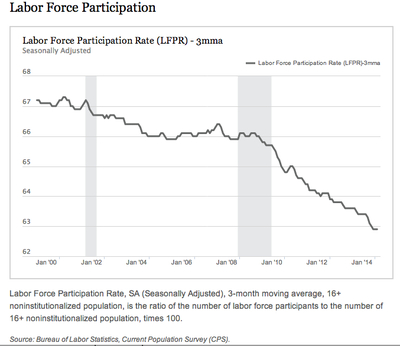
Chart of the DayMarch 12, 2014 at 12:39 pm This graph from the Federal Reserve Bank of New York shows the labor force participation rate.
The $66,400 KiaMarch 11, 2014 at 8:52 pm A Kia automobile now costs $66,400 and an apartment on First Avenue now costs $37.94 million. Meanwhile, Paul Krugman mocks anyone who predicted inflation.
Richard Epstein on Property RightsMarch 11, 2014 at 11:38 am Libertarian (or classical liberal) law professor Richard Epstein's column this week is about property rights:
House Republicans Ready Tax on Harvard, YaleMarch 11, 2014 at 11:34 am House Republicans are plotting a $1.7 billion tax increase aimed at America's most elite private colleges and universities, my column this week reports. Harvard alone would pay roughly $30 million in tax for a single year in which a $30 billion endowment earned a ten percent return. Yale would pay a $20 million federal tax for a year in which its roughly $20 billion endowment earned a 10 percent return. Please check out the column at the New York Sun here or at Reason here.
The Tax Angle on the Banana MergerMarch 10, 2014 at 8:49 pm The company that results from the merger between banana giants Chiquita and Fyffes will be "domiciled in Ireland for tax purposes," Reuters reports. Earlier recent examples of American companies merging into foreign ones, in part for the tax benefits of avoiding the high U.S. corporate tax rates and rules that tax global profits: Forest Labs, Jim Beam.
Ackman and HerbalifeMarch 10, 2014 at 11:54 am The New York Times has a long article detailing the lobbying on both sides, but particularly Bill Ackman's short-selling side, of the battle over Herbalife. Earlier coverage of Herbalife and of Mr. Ackman from this site is here, here, and here. Not among the three bylines on the Times article is Alison Leigh Cowan, who was described in the book Confidence Game as Mr. Ackman's pipeline into the Times. The Times article reports:
|
Follow Us On: 


ADVERTISEMENT Archives by Topic
|
 Continue Reading