New York magazine has a long interview with Barney Frank that is interesting for all sorts of reasons, one of which is this scene:
You were talking about the Republicans and not being able to work with them. But isn't your ultimate beef with the voters, since it's the voters who reward that behavior? I'm glad you said that, you're very smart. These days, in developed countries, everybody says you need a private sector to create wealth, you need a public sector to create rules by which wealth is created. Sensible people understand that. The tension between left and right has been where you draw that line, but it's been a contest between people who see maybe a 20 percent overlap. Let me read this to you. [Picks up copy of Friedrich von Hayek's The Road to Serfdom.] "In no system that could be rationally defended would the state just do nothing." [Closes book.]
Ian Cumming and Joseph Steinberg are out with their annual letter to shareholders of Leucadia National Corporation, which may be of interest to non-shareholders because of its commentary on some public policy issues:
From a piece in the New Yorker on income inequality, written by Columbia Journalism School dean Nicholas Lemann:
Politics does feel sour and contentious in ways that seem to flow from the country's economic distress. Yet much of the ambient discontent is directed toward government—the government that kept the recession from turning into a depression. Why isn't politics about what you'd expect it to be about?
Bloomberg News has a useful article about all the ways that it would be possible to get around the Buffett Rule if it passed. According to the article, the rule would not apply to income from tax-free municipal bonds, so it would create a much greater incentive to invest in those rather than in stocks or corporate bonds. Also, "Because the Buffett rule would effectively deny the benefits of the state and local tax deduction, it would create a greater-than-usual incentive to move to a state such as Florida with no income tax." Funny, I haven't heard President Obama or Warren Buffett or Whitney Tilson talking much about the tax break on municipal bond interest as they go around making the case for the Buffett Tax.
A new rule from the National Labor Relations Board requiring employers to put up posters informing employees of their right to form a union was the subject of a post here in August 2011. Now a federal judge in South Carolina, David Norton, in a case brought by the Chamber of Commerce, has reportedly ruled that the NLRB lacks the legal authority to impose this requirement.
Former Obama administration official Steven Rattner has an op-ed in the New York Times accusing the administration of dishonest accounting in financing ObamaCare.
President Obama has released his tax return, which you can look at for yourself here. Two things popped out for me. First, the return was 48 pages long, which, given that Mr. Obama's affairs aren't particularly complex, is a good argument for tax simplification. Second, Mr. Obama seems to have nearly all his money invested in Treasury Bills or other U.S. government bonds. Maybe he sees that as a way of avoiding a conflict of interest, but he could get around that with a blind trust. He is giving up a lot of potential return that way, given the low interest rates (and one could perhaps argue that there he actually does have a conflict of interest, because changes in the interest rates, which he has some sway over indirectly, would affect the yield and price of the bonds). In any event, in choosing where to put his own money, Mr. Obama seems to have gone with the public sector rather than the private sector. On his Illinois return, he declared $10,623 in "U.S. Treasury bonds, bills, notes, savings bonds, and U.S. agency interest from U.S. 1040A or 1040." All he had in ordinary dividends was $3. Maybe his stocks and corporate bonds are all in his retirement account, and he just keeps the government bonds in his taxable account to minimize taxes. Or maybe all his stocks are long-term holdings of stocks that don't pay dividends. But it strikes me as an unusual profile.
President Obama did an event in Washington yesterday with a group called Patriotic Millionaires for Fiscal Strength that wants to raise taxes on Americans with $1 million or more of annual income. One member of the group, Whitney Tilson, has an op-ed piece in the Washington Post in which he writes, in part:
I think that most people who complain about our government have no idea what they're talking about because they've never been to a country with a bad government. I regularly visit Kenya (my parents retired there and my sister works there), I visited Ethiopia many times when my parents lived there, and growing up I lived for three years each in Tanzania and Nicaragua. So I've seen what life is like under corrupt, dysfunctional, underfunded governments. To quote Hobbes, it can be "solitary, poor, nasty, brutish and short."
America is in dire need of the sort of comity Mr Obama promised in 2008. We are not red states and blue states, he said then, we are the United States. What a pity that he is changing tack this time, bashing the rich via gimmicks such as the "Buffett rule" (which is supposed to make millionaires like Mr Romney pay at least the same tax rate as their secretaries) and galvanising his base by brushing aside even the sensible part of the Republican argument that something radical must be done to curb entitlement spending. He may feel he has no choice. But it is a miserable portent for the future.
Here is the CEO of the publisher Macmillan, John Sargent, on the Justice Department's antitrust lawsuit against publishers alleging collusion on pricing of electronic books:
The terms the DOJ demanded were too onerous. After careful consideration, we came to the conclusion that the terms could have allowed Amazon to recover the monopoly position it had been building before our switch to the agency model. We also felt the settlement the DOJ wanted to impose would have a very negative and long term impact on those who sell books for a living, from the largest chain stores to the smallest independents...
Libertarian law professor Richard Epstein's weekly column is about the difference between laissez-faire and the Social Darwinism that President Obama mentioned critically last week.
The chairman of the Republican National Committee, Reince Priebus, has a piece pushing back against President Obama's proposed Buffett Rule: "He wants to divide the electorate with class warfare to distract us from his failed policies."
Paul Ryan used this same "divide and distract" accusation against Mr. Obama yesterday in that speech at the Bush Institute conference. It may be a talking point, but there's probably some truth to it.
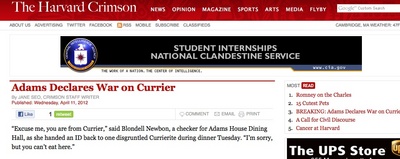
The Central Intelligence Agency's National Clandestine Service is placing banner ads on the Harvard Crimson Web site advertising student internships.
The only problem is that when you click on the ad, it leads not to a CIA page about the internship, but to an "error code: 301 -Moved Permanently" page on the CIA site. Maybe it's a clever way to screen the internship applicants? Or maybe it's just a waste of taxpayer money.
Most of my day yesterday was spent at the George W. Bush Institute's conference on "Tax Policies for 4% Growth." Highlights:
From President Bush's speech, delivered with no teleprompter: "I wish they weren't called the Bush tax cuts. If they were called some other body's tax cuts, they'd probably be less likely to be raised."
President Bush on the proposed Buffett Tax, as paraphrased by the governor of Tennessee, Bill Haslam: "I would hate to have a tax increase named after me permanently. Only thing worse would be a maximum security prison."
Governor Chris Christie of New Jersey stressed the relationships he had developed with Democrats in the New Jersey state legislature. "Compromise is not a dirty word," Mr. Christie said. He also warned, "We're turning into a paternalistic entitlement society" of "a bunch of people sitting on a couch waiting for their next government check."

 Continue Reading