From Mike Allen's Politico Playbook: "This is the kind of thing that Republicans could easily seize on as a prime example of how Washington is broken. Democrats meeting behind closed doors with 400 lobbyists to talk about how they can keep their hands on the taxpayer cash."

A Prime ExampleFebruary 4, 2011 at 8:41 am
Deepwater Drilling BanFebruary 4, 2011 at 8:12 am A federal judge in Louisiana, Martin Feldman, has found the federal government in contempt of court for defying his order striking down a ban on deepwater drilling in the Gulf of Mexico. Bloomberg News reports:
Sanders on ImmeltFebruary 3, 2011 at 8:56 pm Senator Bernie Sanders of Vermont, a self-described socialist, isn't generally my cup of tea, but this YouTube video of Senator Sanders discussing President Obama's new job-creation adviser, Jeffrey Immelt, is worth a listen. There's a certain amount of convergence between the libertarian right and the anti-corporate left when it comes to suspicion of close alliances between big business and big government, and this is an example of that:
Eminent Domain in NYCFebruary 3, 2011 at 11:30 am The Wall Street Journal notices the Bloomberg administration preparing to seize private property in Queens by eminent domain, then to "solicit bids from a set of developers who have previously showed interested in the site, including Related Cos., Muss Development and Sterling Equities." If Related, Muss, or Sterling want to build on this site, you'd think they'd be able to pay a market-clearing price for the land rather than use the power of the government to take it from its current owners.
More ObamaCare ResultsFebruary 3, 2011 at 10:59 am Aetna is pulling out of the individual health insurance market in Colorado, stopping writing new policies and canceling existing ones, we reported here yesterday. Now Karl Rove reports on two other insurance companies that are responding to ObamaCare by getting out of the health insurance business: "Providers such as Guardian Life and the Principal Financial Group are dropping their health-insurance businesses." Sure enough, Employee Benefit Adviser reported January 28:
The 1099 17February 3, 2011 at 10:41 am The Senate voted 81 to 17 yesterday to repeal the requirement under ObamaCare that businesses file a form 1099 with the IRS for any vendor they pay more than $600 a year. President Obama has said he favored the repeal. Here are the names of the 17 senators who voted to keep that recordkeeping burden in place:
Quite a crew.
Government Is Bigger Than It AdmitsFebruary 3, 2011 at 10:17 am The director of the Urban-Brookings Tax Policy Center, Donald Marron, had an interesting point in testimony yesterday before the Senate budget committee about how tax expenditures obscure the size of the federal government:
SEC BudgetFebruary 3, 2011 at 9:36 am The New York Times takes a somewhat skeptical look at the Securities and Exchange Commission:
More:
Bloomberg News on EgyptFebruary 3, 2011 at 9:29 am Commentary magazine's group blog, Contentions, has published an item I wrote about Bloomberg News's coverage of the turmoil in the Middle East.
review of Triumph of the CityFebruary 2, 2011 at 2:54 pm Triumph of the City, by a professor of economics at Harvard, Edward Glaeser, who is also a senior fellow at the Manhattan Institute, is two really wonderful books and one really awful book all wrapped into one. The first book, which is terrific, is a brisk and accessible tour through a series of real-life experiments deeply grounded in data. Here is Professor Glaeser on grocery store checkout clerks: "As anyone who has been to a grocery store knows, checkout clerks differ widely in their speed and competence. In one major chain, clerks with differing abilities are more or less randomly shuffled across shifts, which enabled two economists to look at the impact of productive peers. It turns out that the productivity of average clerks rises substantially when there is a star clerk working on their shift, and those same average clerks get worse when their shift is filled with below-average clerks."
ObamaCare ResultsFebruary 2, 2011 at 9:51 am Aetna is responding to ObamaCare in Colorado, The Denver Business Journal reports:
Economic Causes of the Egyptian RevolutionFebruary 2, 2011 at 12:23 am With the left already, believe it or not, rushing to blame the unrest in Egypt on the dastardly combination of income inequality — "Egypt's top quintile of earners has increased its share of income since the 1990s, while the country's bottom quintile has seen its portion of the pie get smaller" — and "commodity speculation by hedge funds," it's worth getting into the economic explanations from a free-market perspective. The more one looks into it, the more one finds that Egypt bears the scars of socialism. This dispatch from Time magazine from 1962 tells the story aptly: "For most of the past decade, Gamal Abdel Nasser's one-man rule of Egypt has rested on a two-word slogan: 'Arab socialism.' Brandishing this vague concept, Nasser has expropriated private property..."
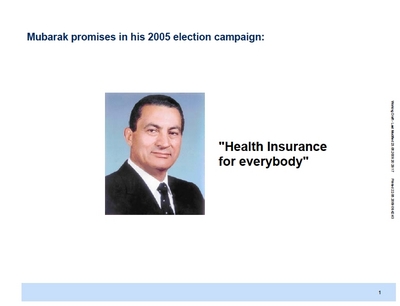
How Health Reform Toppled MubarakFebruary 1, 2011 at 10:33 pm More on this shortly, but for now, just feature these two slides from a presentation by an Egyptian ministry of health official in Washington in 2009:
Jeff Sachs on Taxing the RichFebruary 1, 2011 at 11:56 am A professor of economics at Columbia University and director of its Earth Institute, Jeffrey Sachs, writes:
Read It Here FirstFebruary 1, 2011 at 7:27 am One Medical Group, the subject of a post here on January 20, is the topic of a news article in today's New York Times. It turns out the practice has venture capital funding from Benchmark Capital. As we mentioned in the first place, the market and technology are moving to address some of the problems that ObamaCare was intended to fix.
|
Follow Us On: 


ADVERTISEMENT Archives by Topic
|
 Continue Reading