Stephen Moore has an op-ed in the Wall Street Journal about President Obama's claim that rich people want to pay more taxes. He writes: "When taxpayer groups in Massachusetts won an income tax rate cut to 5.3% from 5.85% in 2001, they created an option for those opposed to the cut to file at the old rate. But according to Massachusetts tax records, each year only about 1,000 tax-me-more enthusiasts—fewer than 0.1% of the state's residents—choose the optional higher tax rate. The total raised in voluntary tax contributions for the past tax year was a pitiful $69,000...when liberals say they want higher taxes, they mean on you."

Stephen Moore on Rich Tax-RaisersMay 5, 2011 at 9:19 pm
Martin Feldstein on Tax ExpendituresMay 5, 2011 at 10:35 am A good use of one of your 20 free articles on NYTimes.com this month might be reading my old Harvard economics professor Martin Feldstein's op-ed, which appears under the headline, "Raise Taxes, but Not Tax Rates." He writes:
Donors and CollegesMay 5, 2011 at 9:05 am Bloomberg News has a pretty interesting look at how much control donors to some colleges and universities are getting in exchange for their gifts. The lead anecdote is John Allison, who has gotten Ayn Rand's work taught in a lot of colleges. Such arrangements are almost certainly better than the alternative, which is that the colleges take donor money and use it to support things that the donor opposes. But the deals also raise questions of the sort that former Bush administration official Noam Neusner wrote about the other day: if charities are just another form of conspicuous consumption for which the donor is receiving something of value in return, why do they get a tax break? Daniel Henninger's suggestion last week — "Eliminate the charitable deduction, drop—or flatten—the top tax rate and total giving will rise, not fall" — was an intriguing one.
Job-Creation, Obama-StyleMay 5, 2011 at 8:29 am Bloomberg News notices that Google is advertising for an antitrust lawyer. More:
Nothing against lawyers, who include some fine folk and who perform some valuable functions in our society. But what's be better for Google's long-term growth and for the American economy — if the company were hiring programmers or software engineers to build new products or improve its existing ones, or if the company is instead hiring antitrust lawyers to fight with government antitrust lawyers? Disclosure: I own some shares of Google.
Caroline Baum on the BehemothMay 5, 2011 at 8:20 am Bloomberg News's Caroline Baum writes: "The federal government has exceeded its "enumerated powers" as outlined in Article 1, Section 8, to such a degree it's become an unrecognizable, unmanageable behemoth, with tentacles reaching into all facets of our lives."
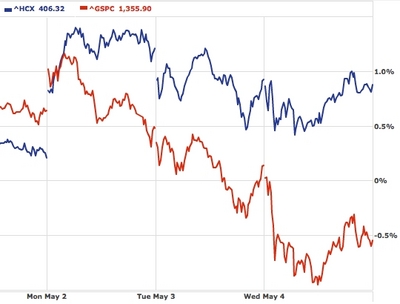
The Bin Laden Health-Care-Stock RallyMay 4, 2011 at 9:43 pm How about this for the chart of the day?:
Columbia Honors Al JazeeraMay 4, 2011 at 12:02 pm "Columbia University's Graduate School of Journalism will bestow its highest honor, the Columbia Journalism Award, to Al Jazeera English. The award is given annually during the school's commencement ceremony to recognize an individual or organization for 'singular journalism in the public interest,'" a Columbia Journalism School press release announces. The latest gem from the Al Jazeera English Web site is a news article about the death of Osama bin Laden headlined "Formenting Nationalism With Murder." It's not clear whether the "murder" meant by the headline is that committed by Bin Laden or the action taken by U.S. forces in Pakistan, but, to judge by the tone of the article, it may well be the latter:
League of Women Voters Vs. Scott BrownMay 4, 2011 at 9:49 am The League of Women Voters is airing an attack ad against Senator Scott Brown of Massachusetts for voting against a carbon tax. The ad features a mother with a child breathing in a mask. The Worcester Telegram & Gazette has an editorial with details calling the ad "nonsense" and calling for it to be withdrawn.
Both Parties Do ItMay 4, 2011 at 7:35 am From a Bloomberg News column by Rory Lancman, a Democrat who is a member of the New York State Assembly, about the Martin Act that New York attorney generals use against the financial services industry:
Census Question of the DayMay 3, 2011 at 1:54 pm From the Census Bureau's required "organizational and practices" survey, out today:
Tough choice there between the first and the last. Maybe they should add a fifth choice, "We didn't even notice the quality defect because we were too busy answering questions from the government, which thinks it knows better than us how to run our business." Thanks to reader-participant-community member-watchdog-content co-creator D. for sending the tip.
U.S. Sues MortgageIt, Deutsche BankMay 3, 2011 at 12:27 pm The Department of Justice's civil fraud lawsuit against MortgageIt and Deutsche Bank seeking upwards of $2 billion struck me as newsworthy on at least two counts. First, during the period in which Deutsche Bank's MortgageIt unit was allegedly defrauding the government and during which Deutsche Bank acquired the allegedly fraudulent mortgage unit for $430 million, a top in-house lawyer at Deutsche Bank was Robert Khuzami, who is now the director of enforcement at the SEC. Mr. Khuzami is not named in the suit or accused of any wrongdoing, but it sure will be interesting to see whether he had any role in the acquisition or in the transactions at issue.
Averages and IncomesMay 3, 2011 at 9:55 am From a Wall Street Journal news article today headlined "High-Earning Households Pay Growing Share of Taxes":
USA Today on Government PayMay 3, 2011 at 9:05 am USA Today has been doing some really fine work on government pay. The latest example is an article today reporting that there are "at least 17,828 federal employees whose annualized salaries totaled $180,000 or more in September 2010." More: "their ranks soared from the 805 with annualized salaries of $180,000 or more in 2005." Among the 17,828 federal employees earning $180,000 a year or more are 598 SEC lawyers and 12,708 doctors at the Veterans Administration. Then there's this:
Shlaes on a New Gramm-RudmanMay 3, 2011 at 8:42 am Amity Shlaes has a Bloomberg column digging into the details of the new Gramm-Rudman being discussed as part of a budget deal:
The Dodd-Frank Paper TrailMay 2, 2011 at 10:56 am The Wall Street Journal has a nifty news article about the amount of paper generated in Washington by Dodd-Frank-related rulemaking. "The process has produced more than three million words in the Federal Register—or more than 3,500 11-inch-high pages," which the Journal says laid end-to-end would be the equivalent of 2.6 Empire State Buildings. "And about 62% of the 387 sets of rules required by the law haven't even been proposed, according to law firm Davis Polk & Wardwell." Imagine the number of lawyers and lobbyists a company has to pay to attempt to keep track of all this stuff.
|
Follow Us On: 


ADVERTISEMENT Archives by Topic
|
 Continue Reading