We've been tracking the increased openness on the center-right to new or increased federal taxes: David Brooks, Glenn Hubbard, Karl Rove, Tyler Cowen, Greg Mankiw. The latest example comes in the new Spring issue of National Affairs, which bills itself as the successor to Irving Kristol's Public Interest. There, Donald Marron, who served on President George W. Bush's Council of Economic Advisers (as did Professor Hubbard and Professor Mankiw), writes: "No one solution — not economic growth, not tax increases, and not spending reductions — can get us to our goal. To put ourselves on a sustainable fiscal trajectory, we will need to use all the measures at our disposal." Or, to be more blunt: "some tax increases will almost certainly be required."
"If Paterson and Bloomberg wanted to discourage obesity by imposing taxes, they could raise the tax on televisions, or on cable television service. All kinds of studies have shown links between sedentary behavior like television watching and obesity." -- me, in a Daily News op-ed about New York's proposed soda tax, March 10, 2010.
"Why aren't we going after computer and cable-TV companies for creating a sedentary lifestyle?" -- PepsiCo CEO Indra Nooyi, in the March 25, 2010 Economist.
For what it's worth, the advocates of the soda tax say that the increase in overweightness and obesity over the past 30 years is about 80% attributable to increased caloric intake and 20% attributable to decreased activity, so they say they are going after the heart of the problem.
Connecticut-based money manager Clifford Asness has a new essay posted on his StumblingOnTruth.com Web site. Some highlights:
as most Republicans would now admit, we share a lot of blame for this calamity, at least in the sense of having it happen on our watch. While in power we let government expand, not contract, as is our mandate. We let the easy pabulum of "compassionate conservatism" blind us to the fact that even though compassion is a virtue of the first order, along with benevolence, honesty, and others, these are private not public virtues, and importantly they are not virtues, if not voluntary. When the State claims to practice any of these virtues it is always being generous with someone else's resources, and usually most so to the constituents of whoever is currently in charge, and almost always with eyes firmly on the political advantage it will bring...
The "Harvard-educated doctor" who became president of Dartmouth College July 1 tells the Wall Street Journal that when he took over the job : "I had no idea what a hedge fund was."
"Erich" of Whatwouldthefoundersthink.com writes, "My wife and I sat down and agreed to set aside whatever our legal IRA Savings maximum is this year and give it to candidates who are running against those in Congress who voted for this tyrannical bill." He's got a list of congressional races to target. "What good is it to save money if that money ends up being worthless?"
Add it to the list of examples of American Revolution references I cited earlier: "This will be a grassroots effort like none in our history since ordinary men took action to protect their freedoms in 1776. And that would be a good thing because we have not faced a greater internal threat to our liberties since the founding of our Republic."
Former General Electric chairman Jack Welch was on CNBC earlier this week (video here) and was just scathing about President Obama and the health care overhaul. "These guys believe in a more centralized role for government," he said. "Add more bureaucracy, add more regulations."
"It's a sham on the American people," he said of the claim that the health care law would reduce the deficit. "I think the costs are going to be out of sight."
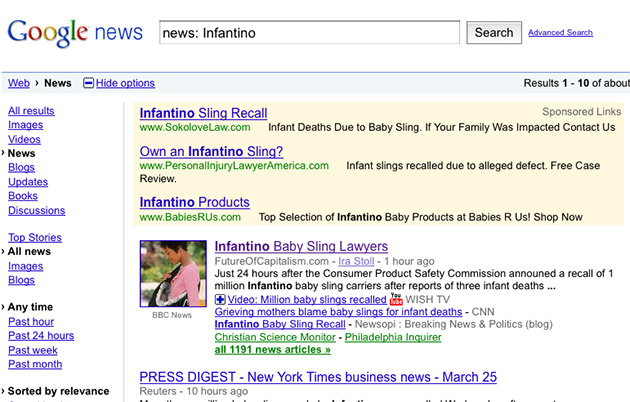
Just 24 hours after the Consumer Product Safety Commission announed a recall of 1 million Infantino baby sling carriers after reports of three infant deaths, ambulance-chasing lawyers are already out on the hunt for clients. "Infant Deaths Due to Baby Sling. If Your Family Was Impacted Contact Us," is the language on the Google ad purchased by the firm of Sokolove Law, LLC. "Own an Infantino Sling?" is the Google ad language that takes you to the Web site of Lieff Cabraser Heimann & Bernstein, LLP, whose Web site includes the disclaimer that "the hiring of legal professionals is an important decision that should not be based on advertising alone."
Even if, like us, you aren't big fans of trial lawyers, it's hard not to marvel at the sheer profit-motive-driven efficiency of the marketing efforts that the firms use to find clients.
Michael Barone has a new column out today arguing that the bond market is starting to indicate the costs of ObamaCare: "No wonder that Moody's declared last week that the Treasury is 'substantially' closer to losing its AAA bond rating." Which is the bigger news here, the U.S. about to lose its AAA bond rating, or a ratings agency finally making an intelligent judgment about risk?
Politco's Josh Gerstein writes that states may be in a better position to sue to challenge after 2014, when the individual mandate to puchase health insurance actually kicks in. Before then, a suit may be "unripe."
The New York state health commissioner, Richard Daines, and I were guests last night on the "Inside City Hall" program of New York City's all-news cable channel, NY1. Dr. Daines made the case for Governor Paterson's proposed new penny-an-ounce tax on sugary beverages. I argued against it.
He said it would help fund New York's health spending. I said New York already spends a lot of money on health care, more on Medicaid than California and Texas combined, but that our people aren't any healthier as a result. I said the politicians in Albany should be trying to figure out ways to cut our taxes, not inventing new taxes to impose.
Dr. Daines said "sugary sodas are unique" because, unlike other caloric foods, "it doesn't fill you up." This point, about what researchers call satiety, is also made by Coca-Cola Co. investor Warren Buffett in this video.
I responded that if soda is really so bad for you, the state should ban it, rather than going into a revenue partnership with the beverage companies.
ProPublica's Olga Pierce notices that, Orwellian Newspeak style, "among the 15 pages of changes to the Reconciliation Act included in the manager's amendment released over the weekend was a wee name change: references to 'Medicare tax' were deleted, and replaced with the much gentler, and voluntary-sounding, 'unearned income Medicare contribution.'" Which is worse, the tax itself or the effort to camouflage it?
The Consumer Product Safety Commission's announcement of a recall of baby sling carriers is a perfect example of some of the issues that come up in thinking about regulation. Is this a success of regulation, because the product was recalled before more deaths resulted? Or is it a failure of regulation, because three children reportedly died in the slings in 2009: "a 7-week-old infant in Philadelphia, Pa.; a 6-day-old infant in Salem, Ore.; and a 3-month-old infant in Cincinnati, Ohio."
I speak from some experience because I owned one of these slings and used it to carry around a newborn in 2007; I think I then gave it away to someone else. The child, who survived the experience, seemed to enjoy being in it, and it was a sure-fire way to get her to sleep.
The American Medical Association, the drug company lobby, and the American Hospital Association all cheered ObamaCare's signing, Timothy Carney writes in his Washington Examiner column.
The New York Times Company has paid $114,000 and apologized to the prime minister of Singapore, Lee Hsien Loong, for an article that included that country in a discussion of Asian family political dynasties, reports Reuters.
The article has been taken down from the Web site of the Times's International Herald Tribune, but a copy is available here, along with a nifty photo illustration of a kangaroo court, apparently intended as commentary on the rule of law in Singapore.
"JP Morgan Paid $1.9B for WaMu and Now It Wants a $1.4B Tax Refund," is the headline in the Business Insider over John Carney's article, which concludes: "our tax code shouldn't be used like this. This rewards the worst managed companies with a subsidy while punishing those that didn't see losses in the crisis. It's got bailout written all over it." At least, if we are going to let companies smooth out their tax liabilities retroactively over five year periods, shouldn't individuals get the same treatment?

 Continue Reading