March 21, 2020 at 8:15 pm
Author and surgeon Atul Gawande writes in the New Yorker of hopeful news from Hong Kong and Singapore: this coronavirus, even though it appears to be more contagious than the flu, can still be managed by the standard public-health playbook: social distancing, basic hand hygiene and cleaning, targeted isolation and quarantine of the ill and those with high-risk exposure, a surge in health-care capacity (supplies, testing, personnel, wards), and coördinated, unified public communications with clear, transparent, up-to-date guidelines and data....Those of us who must go out into the world and have contact with people don't have to panic if we find out that someone with the coronavirus has been in the same room or stood closer than we wanted for a moment. Transmission seems to occur primarily through sustained exposure in the absence of basic protection or through the lack of hand hygiene after contact with secretions.
Also, he writes, "the risk of asymptomatic contagion could be much lower than we thought."
Submit a Comment
March 20, 2020 at 4:31 pm
David L. Katz MD, MPH, FACPM, FACP, FACLM, founding director of Yale University's Yale-Griffin Prevention Research Center, writing in the New York Times: "I am deeply concerned that the social, economic and public health consequences of this near total meltdown of normal life — schools and businesses closed, gatherings banned — will be long lasting and calamitous, possibly graver than the direct toll of the virus itself. ...I believe we may be ineffectively fighting the contagion even as we are causing economic collapse."
 Continue Reading Continue Reading
March 19, 2020 at 4:43 pm
From an interview with "Nobel laureate Michael Levitt, an American-British-Israeli biophysicist who teaches structural biology at Stanford University": "In exponential growth models, you assume that new people can be infected every day, because you keep meeting new people. But, if you consider your own social circle, you basically meet the same people every day. You can meet new people on public transportation, for example; but even on the bus, after some time most passengers will either be infected or immune." Another reason the infection rate has slowed has to do with the physical distance guidelines. "You don't hug every person you meet on the street now, and you'll avoid meeting face to face with someone that has a cold, like we did," Levitt said. "The more you adhere, the more you can keep infection in check. So, under these circumstances, a carrier will only infect 1.5 people every three days and the rate will keep going down."
As for Italy:
Continue Reading
March 17, 2020 at 8:29 pm
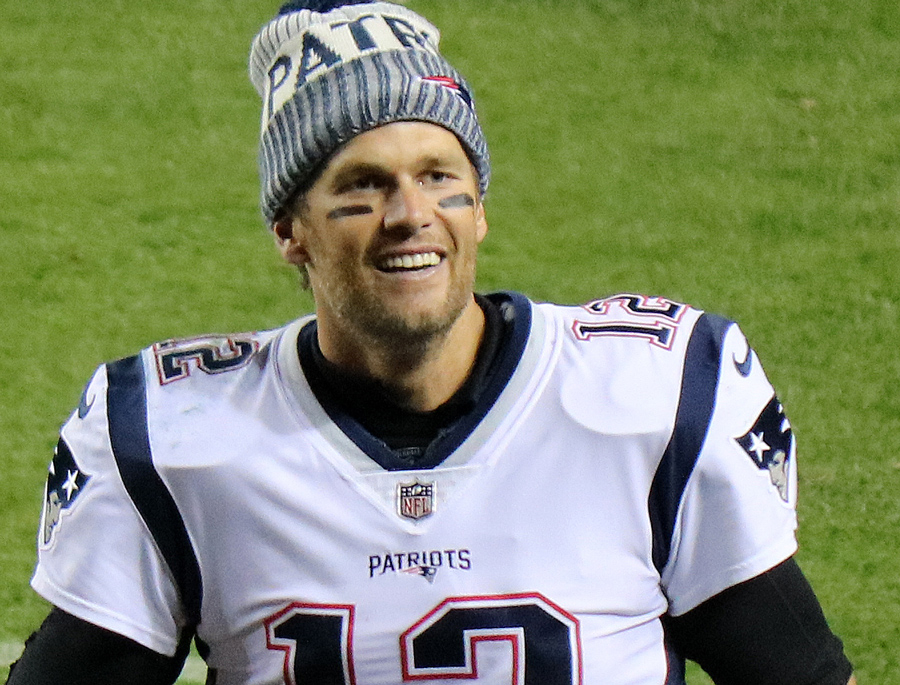
Back on February 10, I noted that a lot of the teams Tom Brady might leave Massachusetts for were places with zero state and local income tax. That means a lot for someone who makes as much money as Brady. I wrote then: States go after athletes with so-called "jock taxes," so Brady can wind up paying state tax when he plays away games in other states, anyway, but a zero state income tax versus 5.05% on home games could amount to more than half a million dollars a year for a guy like Brady. I'm not saying it's the only factor. But it seems to be part of the conversation. Top talent, like capital, flows to where it is well treated.
Sure enough, it looks like Brady is going to end up with the Tampa Bay, Florida, Buccaneers. Florida has no state income tax.
Submit a Comment
March 17, 2020 at 8:19 pm
My column this week is a response to David Brooks, who had claimed that pandemics kill compassion and that they "inflame class divisions." Please read the entire column (mine, not Brooks, though if you want to read Brooks don't let me stop you) at the New York Sun (here), Reason (here), and Newsmax (here). The column was also quoted by the New York Post here.
1 Reader Comment
March 16, 2020 at 6:58 am
One factor I haven't seen written about much in explaining the wild day-to-day gyrations we have been seeing in the stock market is target-date retirement funds. The New York Times recently reported that there is more than $1 trillion in workplace retirement plan money, 21% of the total, in target-date funds, up from $185 billion in 2009. The Wall Street Journal put target-date funds at $1.1 trillion, up from $158 billion in 2008. Say you run a target-date fund aimed at people retiring in 2040 that is supposed to be 50% in U.S. stocks. Then suppose we have a day like Friday when the stock market is up more than 9%. All of a sudden, your stock allocation is over the target. You've got to sell to get back down to the 50% level.
Continue Reading
March 13, 2020 at 8:56 am
An addendum is needed to my post from the other day about "The Eight Ps of Coronavirus Reaction" — preppers, portfolio mangers, politicizers, psychosomatics, panicked, patients, and philosophers. The ninth P is for precedent. At Education Next, in "Searching for Precedents in Pandemics Past," I write about the Spanish Flu and the Black Plague: Harvard in a pandemic, even more than in usual times, is a peculiar place. Other places have runs on hand sanitizer or bottled water. Here people have stocked up on those practical preparedness supplies, too. But here we have also had a run on books, as scholars research relevant precedents to the challenges posed by the novel coronavirus.
Continue Reading
March 10, 2020 at 4:19 am
Joe Biden's fundraising for his presidential campaign from plantiff's lawyers is the topic of my column this week. Please check out the full column at Reason (here), the New York Sun (here), and Newsmax (here).
Submit a Comment
March 7, 2020 at 10:41 pm
People have different ways of reacting to the coronavirus or Covid-19 situation. I have identified at least eight of them, all starting with the letter "P," in a taxonomy that I hope is at least somewhat useful in making sense of a somewhat unusual situation. Preppers go out and buy things to prepare for a potential quarantine or supply chain disruptions. (more Ps: Purell, peanut butter, painkillers, pasta.) Easily mocked, perhaps, but at least adhering to the Boy Scout motto of "Be Prepared." Portfolio managers are mainly focused on the economic fallout of the virus. They are short-selling airline stocks, or rebalancing their portfolios, or buying gold, or checking their retirement accounts, or going to cash, or taking a buying opportunity, or refinancing their mortgages. They see the situation mainly in financial terms.
Continue Reading
March 6, 2020 at 7:46 am
How Covid-19, or the coronavirus, will affect the presidential campaign is the topic of my column this week. Please check out the full column at the New York Sun (here) or Newsmax (here).
Submit a Comment
March 5, 2020 at 6:53 am
Michael Bloomberg's exit from the presidential race makes it more legally complicated for him to carry out his announced plan of spending millions of dollars to defeat President Trump. Here is how an NBC news article summed it up:
Continue Reading
February 27, 2020 at 6:08 am
How big a victory margin will Trump have if Bernie Sanders is the Democratic presidential nominee? That's the topic of my column this week. Please check out the full column at the New York Sun (here), the New Boston Post (here), and Newsmax (here).
Submit a Comment
February 25, 2020 at 10:37 pm
The Washington Post reports on Elizabeth Warren's campaign finances: "New financial reports show the campaign took out a $3 million line of credit and drew out $400,000 that it ended up not using." I scoured her campaign's latest Federal Election Commission report and other press coverage of this line of credit. The name of the person or financial institution providing this $3 million line of credit is not something I was able to find. If it's a bank, though, it's a good example of how the financial industry provides valuable services to customers in ways that Warren and her ideological comrades are often too reluctant to acknowledge.
Continue Reading
February 24, 2020 at 7:53 pm
A New York Times editorial about tension on the Syria-Turkey border says "Turkey is already burdened by almost four million Syrian refugees, whose presence is increasingly becoming a political liability for Mr. Erdogan."
Continue Reading
February 23, 2020 at 8:56 pm
"Two French economists," the New York Times reports, "are the driving force behind proposals for a wealth tax, an idea embraced by Senators Bernie Sanders and Elizabeth Warren." The Times reports that "Four years ago, Mr. Saez and Mr. Zucman pitched the leading Democratic candidates, Hillary Clinton and Mr. Sanders, on their wealth tax proposal, but both campaigns passed. This cycle has been different. Mr. Sanders and Ms. Warren have both proposed wealth taxes." The New Yorker in October 2019 ("The French Economist Who Helped Invent Elizabeth Warren's Wealth Tax") reported more details of how Zucman and Saez interacted with the presidential campaigns:
Continue Reading
<- Prev 15 items | Next 15 items ->
|